In early 2022, after sailing Maru for three months, I knew that ideally, I wanted the same type of boat—just larger. I studied drawings and documentaries about all types and sizes of Wharram catamarans and concluded that the 12-meter (40-foot) category is large enough for decent living. And I was dazzled by the drawings of 20-meter / 60-foot ships—large enough to host a small village.
But Maru was the boat I had, and I was happy and proud to sail her from Sweden to France.
By the end of 2022, I decided to stop the great Maru experiment and look for a larger boat. Out of reach back then—it was pure hope.
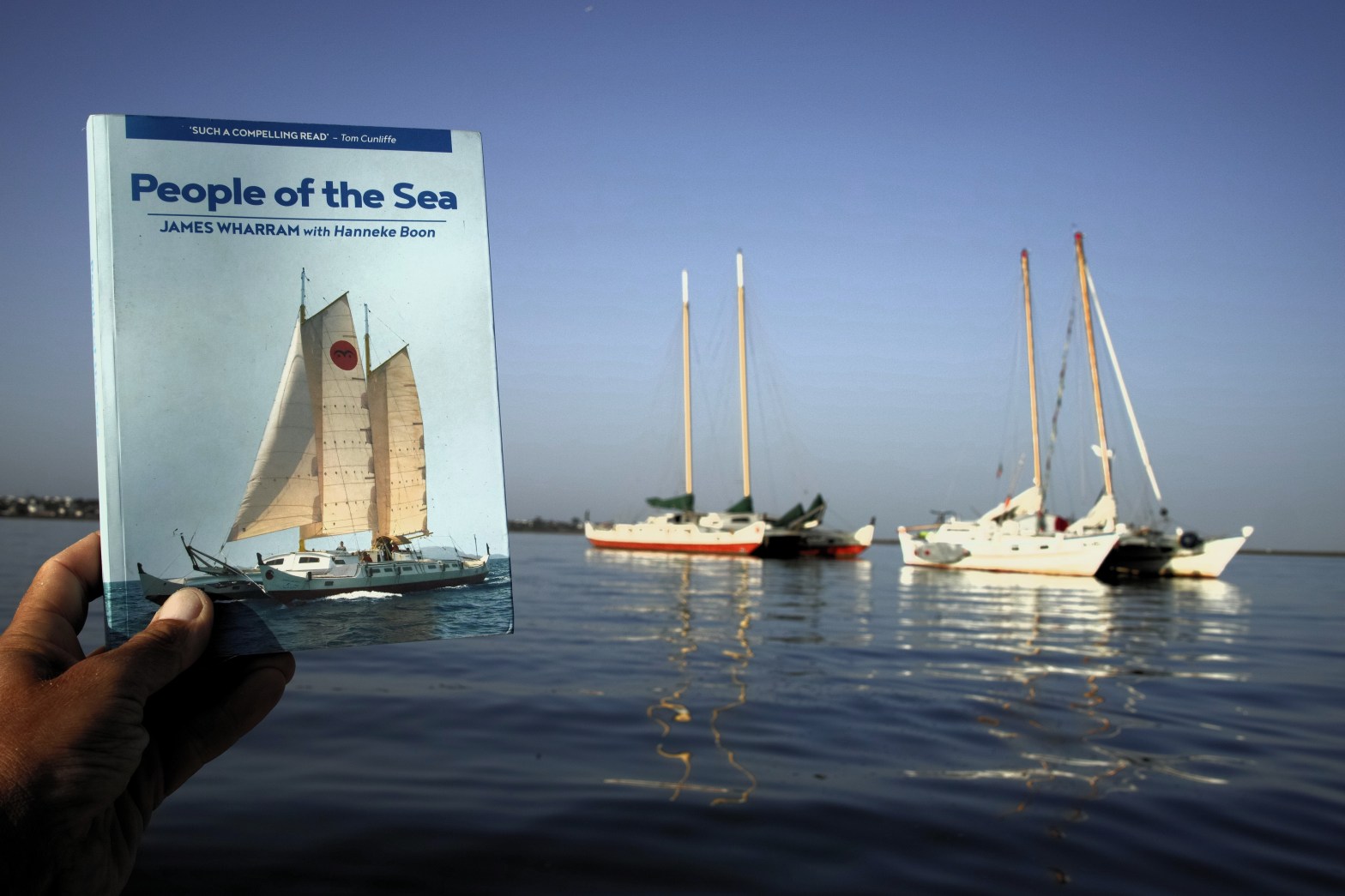
Two attempts to buy a 40-foot catamaran failed due to quality problems in the boats. The Blues opportunity (boat on the right-hand side of the image) turned out to be a success on all levels. I have been living and cruising on the boat for nine months now, and for the past three months without any marina. This has only been possible due to your help!
Sailing Blues autonomously—always on anchor and producing all energy on board—is also a short proof of concept for how a larger boat could operate.
One fantasy loop turned into reality.
The idea of the 60-foot boat never left my heart.
Two days ago, I found Spirit of Gaia in the bay of Culatra / Armona (boat in the centre of the image). This 63-foot giant is not only the flagship model of James Wharram (RIP) and Hanneke Boon’s designs—it is the very boat which James, Hanneke, and many guests personally sailed for decades. She is the holy grail for Wharram sailors. And here I am, paddling around her, looking at every detail. She felt magically attractive and surprisingly familiar. Anchoring next to her feels like an incredible honour.
Another fantasy loop kissing my reality—and diving back into the realm of dreams.
Now Blues is the boat I have. Sailing and living on board makes me happy and proud.
Today it is almost exactly one year since I had left Simrishamn, Sweden, on board of Maru. Coincidentally, it took me also exactly one year to purchase Maru, learn how to sail, sail Maru to Sweden, convert her for ‘sustainability’ and then sail her to Bretagne.
During the previous 12 months I had been busy on other platforms and in real life. Now I am ready to post a summary of events.
Since Januar I am staying around Camaret, Bretagne, France:
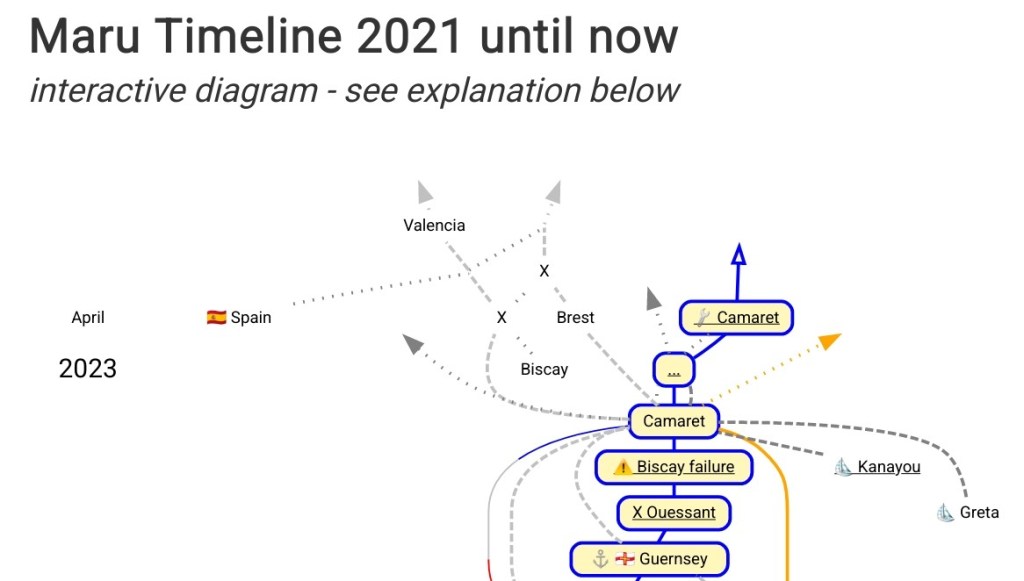
detail from travel map with Camaret as most recent location
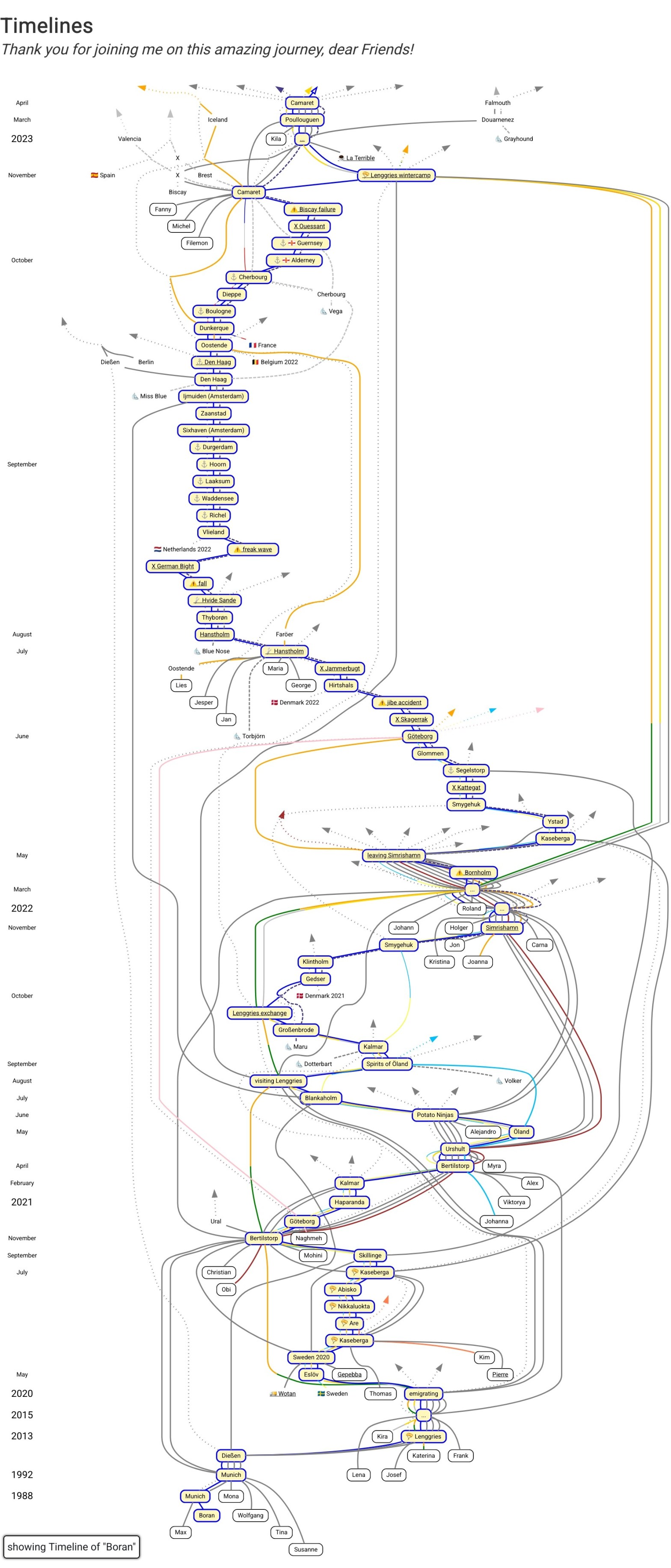
How did I get there? You can browse through the sailing story in this interactive diagram:
Call for people along my route: if I have not included you already in these maps then please let me know. I will be happy to complete the maps with our precious encounter!
Looking forward to seeing you soon somewhere on this small planet ~
research shows: “we agree on much more than we thought we do”
I am not vaccinated against the corona virus. Perhaps you are. This could divide us into two groups of people who can’t understand each other.
You could call me a Conspiracy Theorist. I could call you a Conspiracy Denier. Or, we can try to understand each other and continue being friends. Fellow humans who inhabit the same wonderful planet. Which is more than enough reason for getting along with each other well.
If we find ourselves in these two different groups then my perspective on this situation is: we adhere to different belief systems. Almost like a religion.
Some while ago we have chosen to believe in certain assumptions. Since then we keep believing our own belief system. It is unlikely that either of us will change our beliefs. What members of one belief system call “scientific facts”, the others refuse as “wrong or unproven assumptions”. We even share the same terms and similar logic in our explanations. The difference is just the set of assumptions that we have chosen to believe.
Fortunately we agree on much more than we thought we do.
For example, I assume that we all believe in, and aspire, health.
In our belief systems we hold different assumptions about what is needed to achieve health. Some people smoke. Some exercise sports. Some people smoke and exercise. We have different approaches to health but we do agree on the general concept of health, and that health is an important value.
Similar case for solidarity. Like every human, we all want to contribute to the wellbeing of our society’s members. Based on our own assumptions, we all believe in our own ways of achieving solidarity.
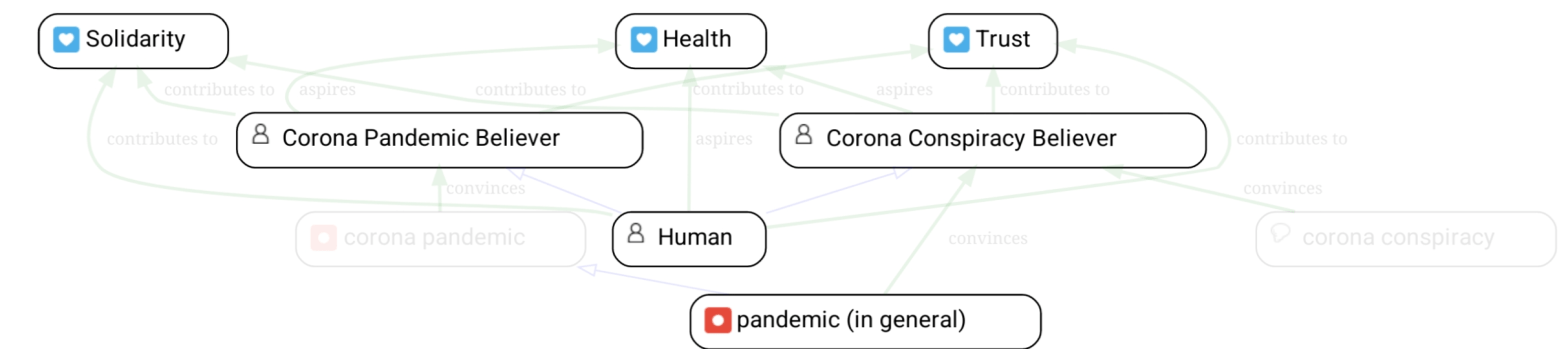
The map to the right highlights some values that we have in common.
We may not agree on the corona pandemic. But we do agree on values like solidarity, trust and health.
In my eyes this represents a lot of agreement.
I am deeply grateful for all the people in my life who value friendship and human connection higher than recent medical beliefs. I believe that we must stay united.
Thank you, my friends!
Revision history
2021-12 first draft (initial title “Pandemic Belief Systems” with more details of my personal opinion about the pandemic question, and therefore less balanced)
2022-07-15 published (new title focussing on friendship, now hopefully well balanced)
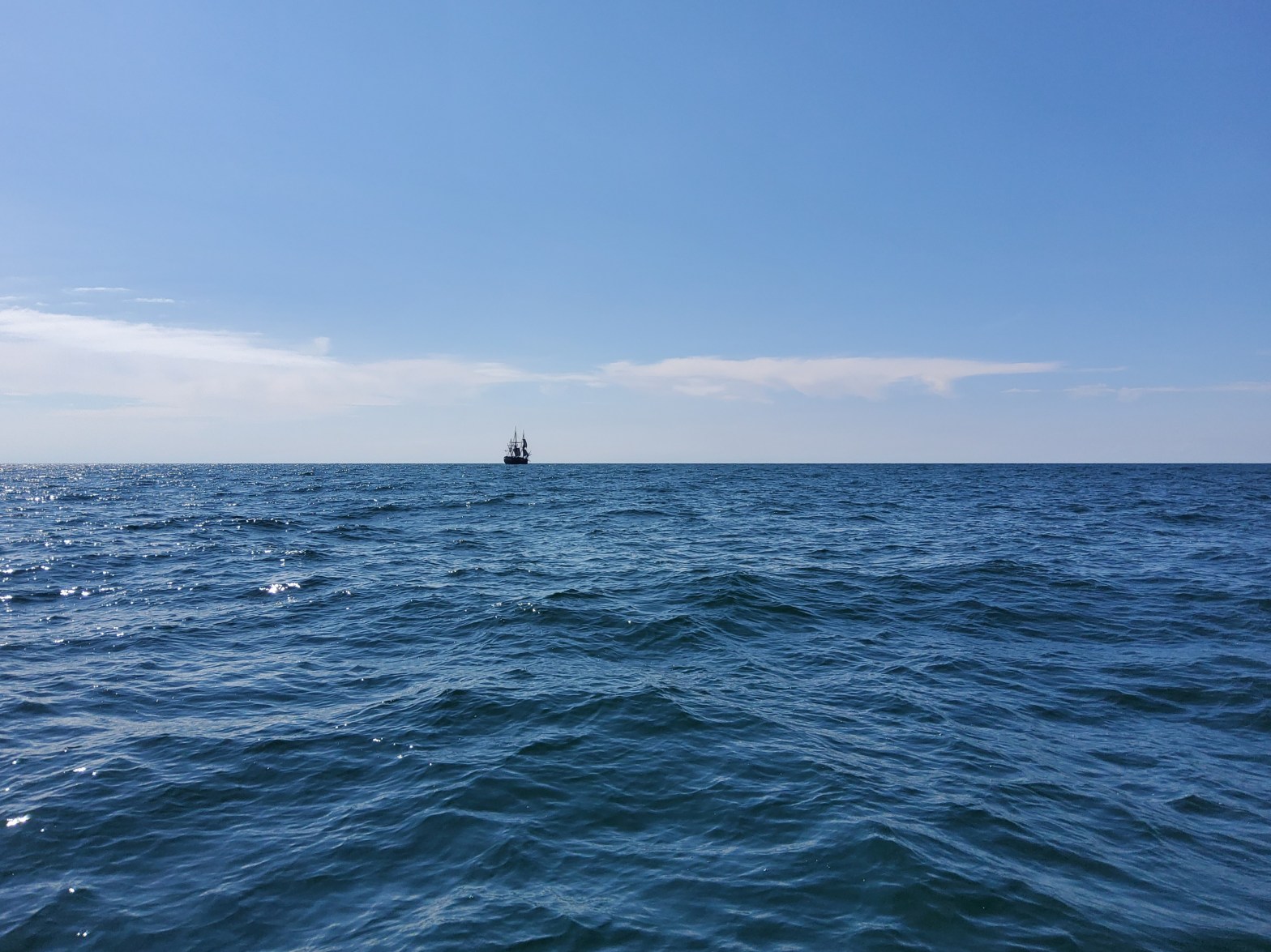
Because a few days earlier I tried to meet Bengt, an old sailor, in Ystad. Bengt was member of the crew on the ship on her Asia expedition 17 years ago. Back then on the same route that I am planning to take. I was hoping for advice and thought exchange of any kind. However, Bengt and I never met because his cancer disease did not leave him energy to see me. So I finally left Ystad with the positive thought that I will continue Bengt’s journey anyway.
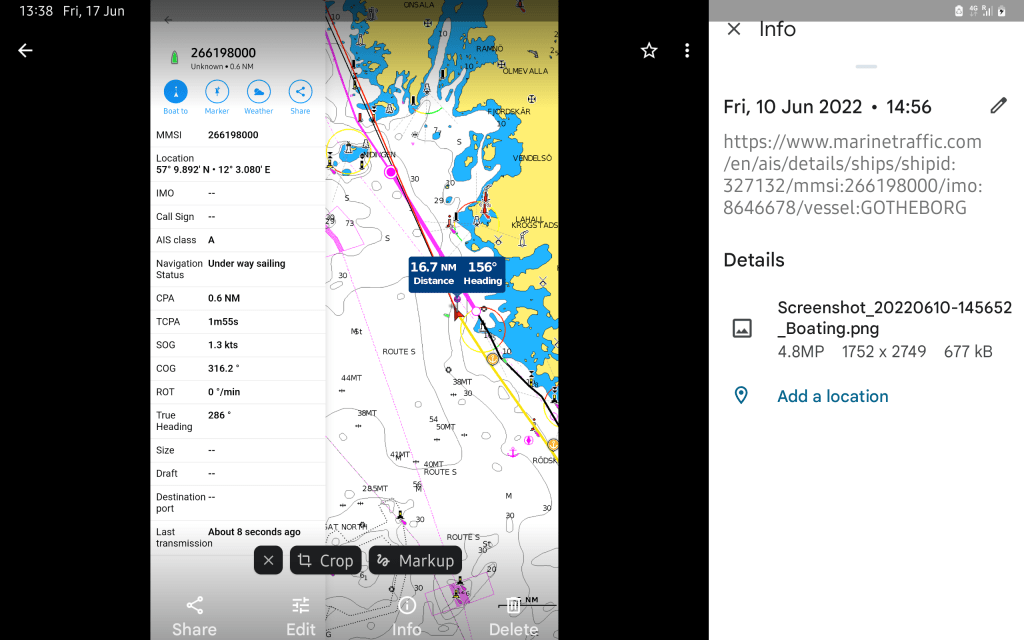
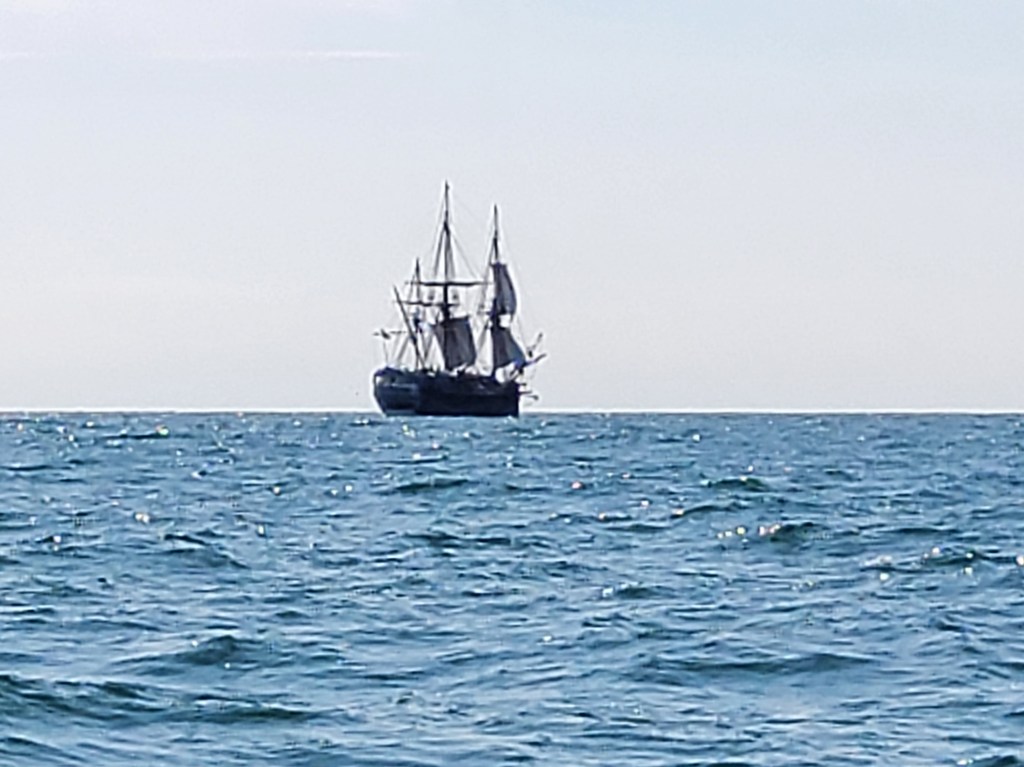
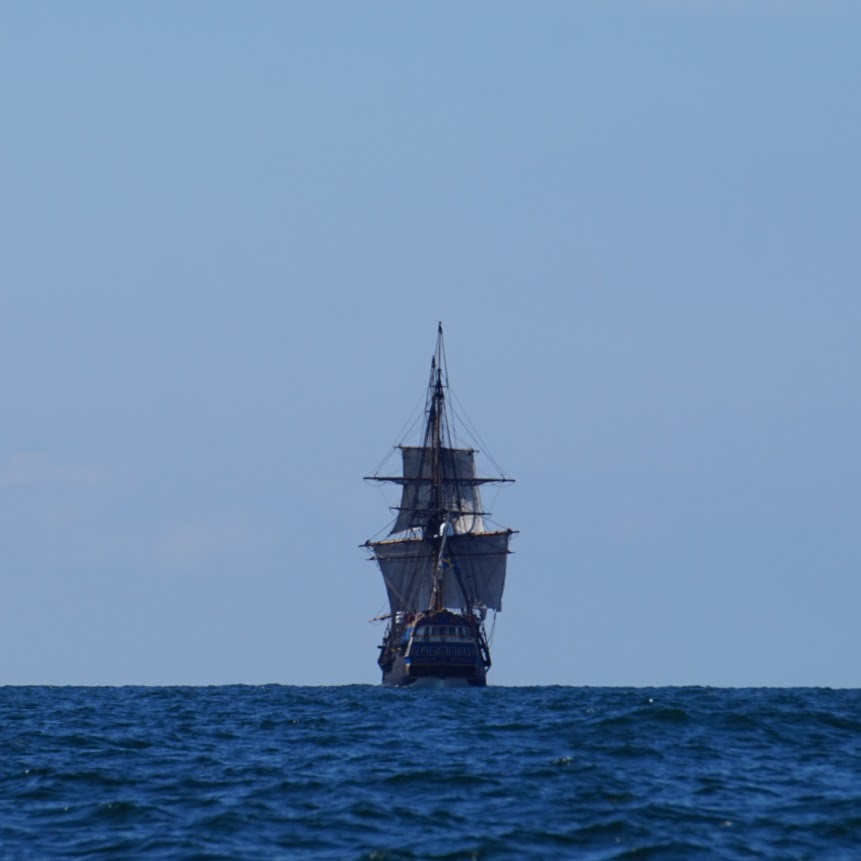
Now my course had crossed the ship’s route much earlier and more physically than I expected.
What is even weirder: Götheborg of Sweden just started another Asia expedition (see homepage). And I am staying in Göteborg right now.
Sure I will follow the ship’s location online. Perhaps we will meet again. Even though this time she will be sailing through the Mediterranean Sea and Suez, whereas I will cross the Atlantic and sail around Africa.
Touring Test continues. In this phase I live on board of Maru, since Monday.
During the last months I prepared this rather small boat with some essential upgrades for single-handed long-distance sailing: auto-helm, AIS receiver, solar panels and wind turbine. Some of that is actually working. One of my goals is to run Maru as a green boat, with no fossil fuels.
Because I am less based on land now I have modified my communication channels. For more reliable updates I will use satellite messengers and some web / mail interfaces. Those channels I summarize here:
Please feel free to follow me on Twitter, Rumble, Telegram or whatever works best for you. Please let me know which channels you find useful, awful or missing.
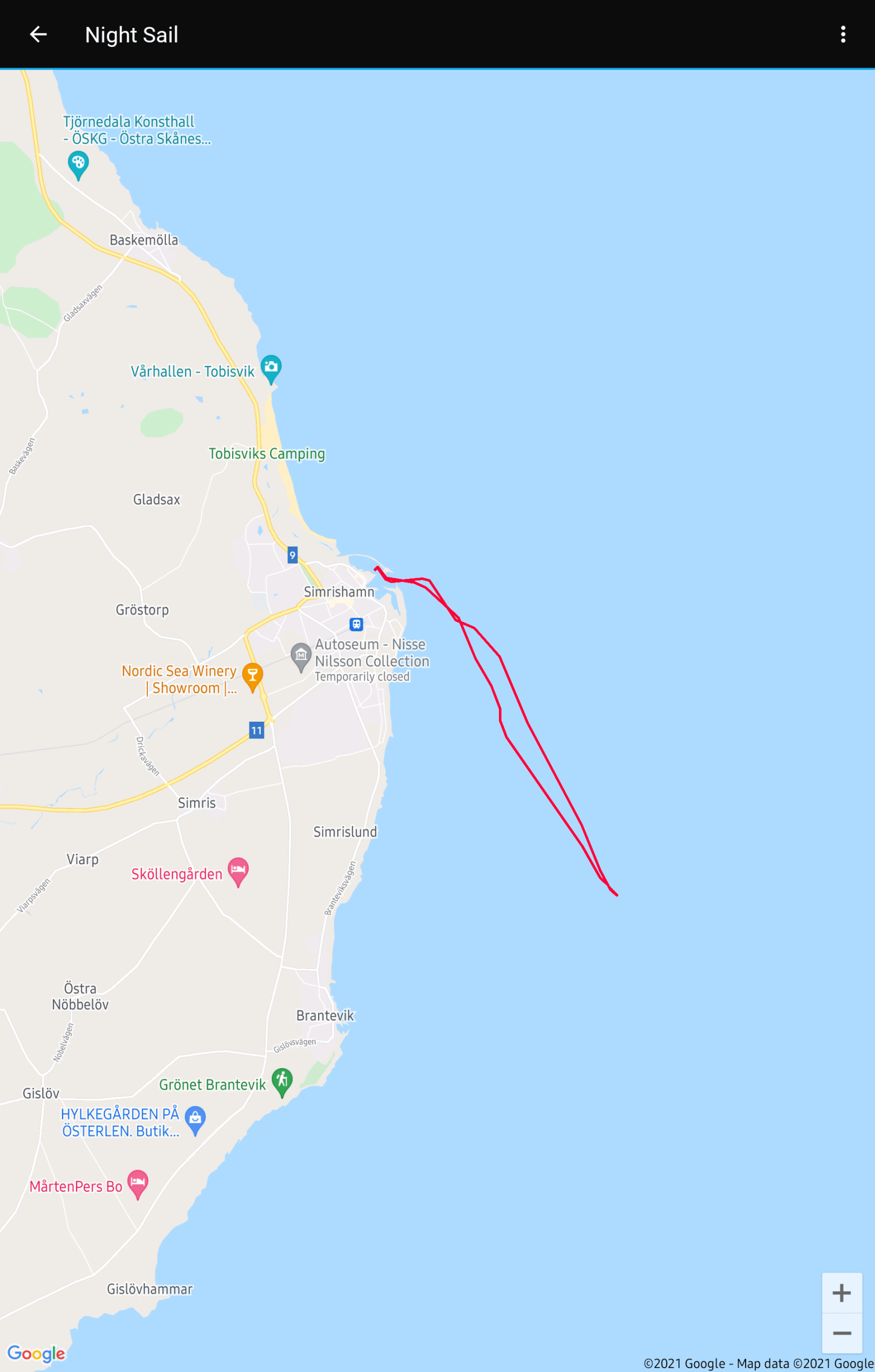
This evening I went for a brief training tour. It was raining. Sailing by rain with a drysuit is better than staying in the harbour and getting wet for no good reason.
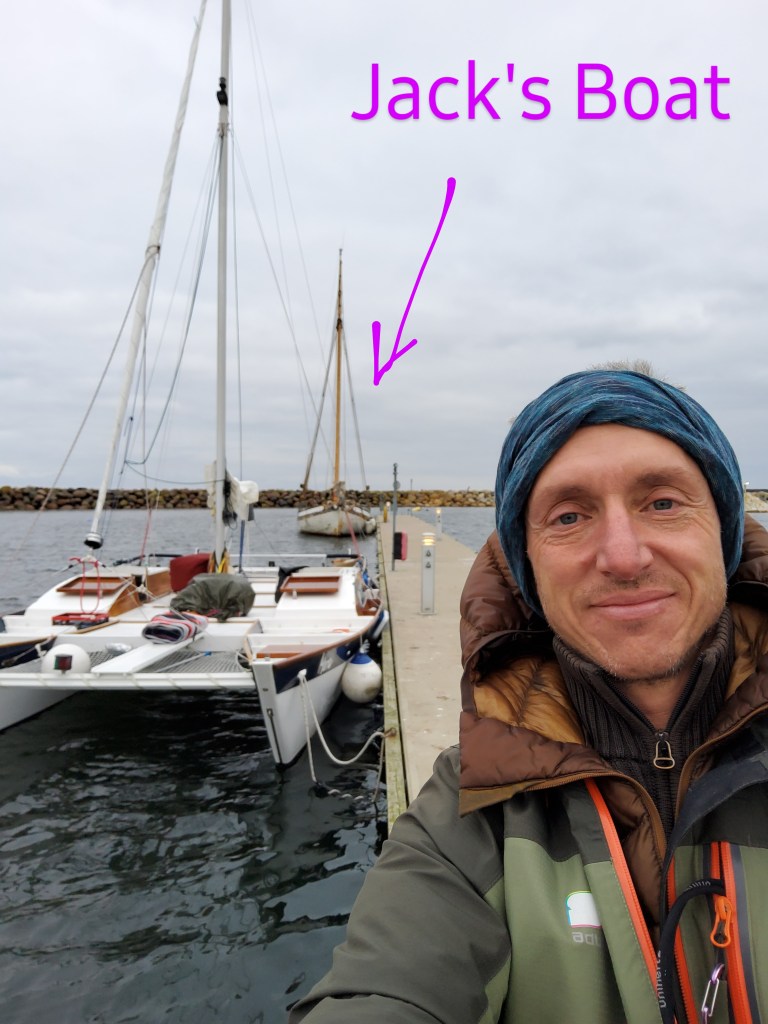
Just before taking off I met my ultranice boat neighbor Jack. A young guy sailing this huge classic wooden boat, parked on the same pier E.
We talked about maneuvering in a harbour without engine, made a little plan (pier review) and I gave it a try. Big success! I managed to leave the harbour under sail, with no engine. So much easier to set the main sail in calm water – no delay after leaving the port. No fuel needed – only natural forces.
Out on the sea the wind was a bit stronger than expected. So I sailed with only one (of two) foresails and still averaged 7 knots.
The horizon faded into pitch-black. On this short trip I could always see the coastline, there was no advanced navigation necessary.
Back in town I ordered a Vikingbåt pizza, then enjoyed my 1 kW electrical heater in the living hull. (Shore power / Landstrom) electricity is flowing only since Monday. After a week with almost no heating this feels like life in the Carribean.
Before I had shore power I used a tiny 12 Volt heater…
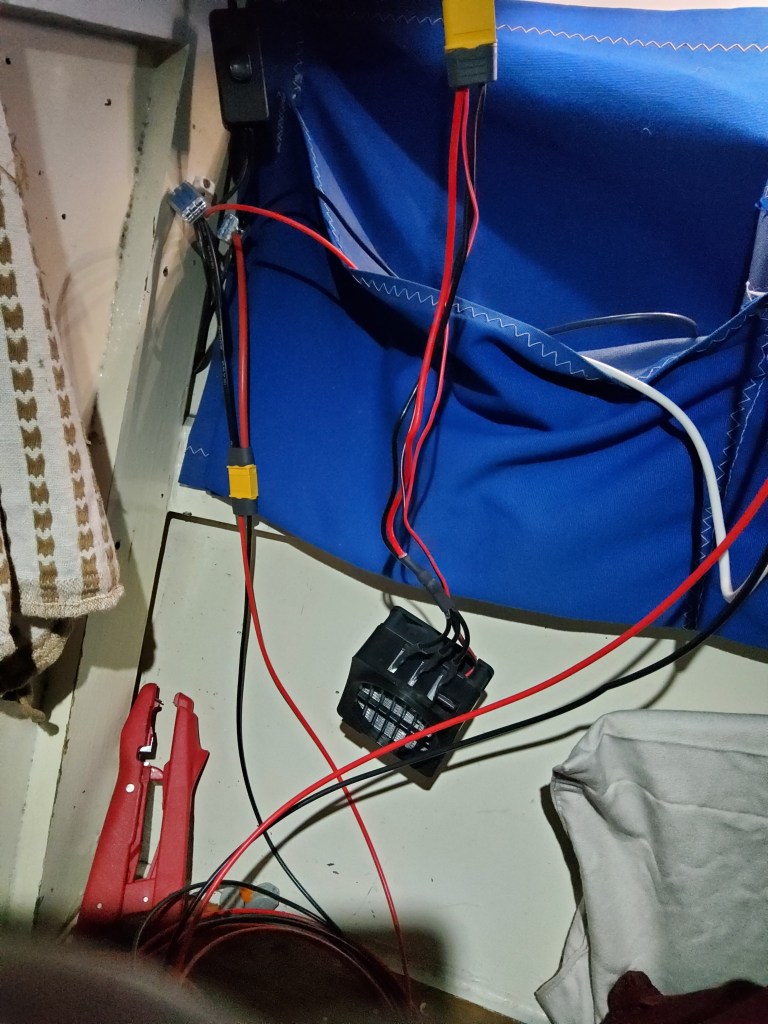
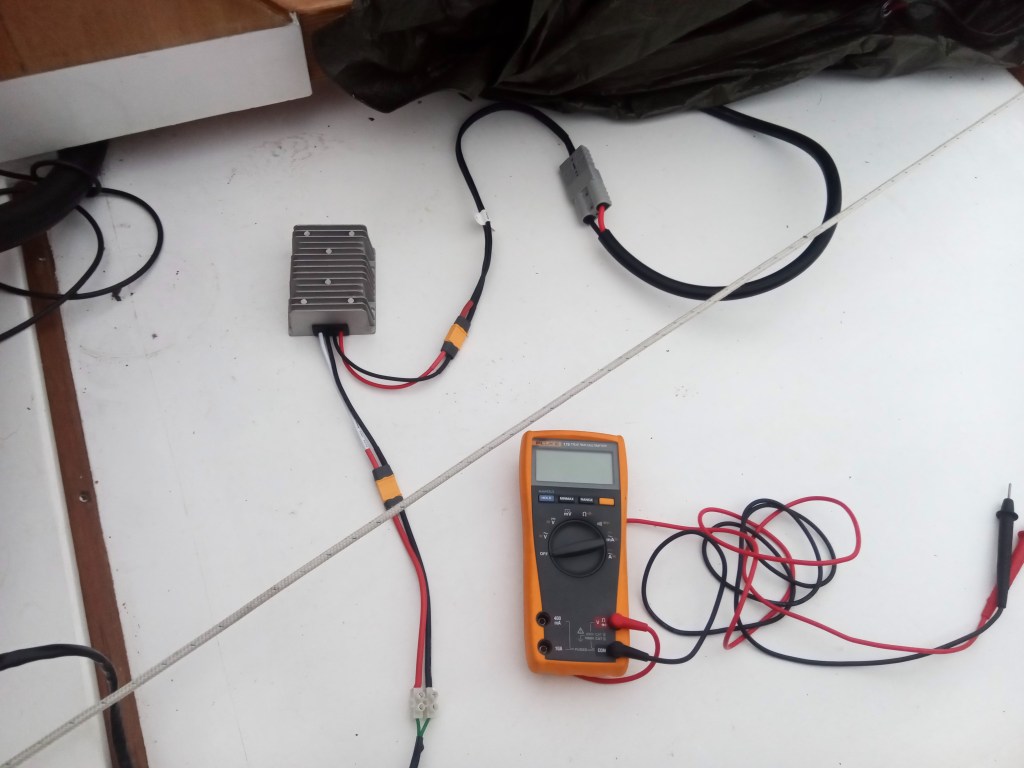
… which was powered by my huge 48 Volt batteries, through a step-down converter:
Besides heating, the 48 Volt -> 12 Volt converter now can power all other 12 Volt devices and charge the 12 Volt lead battery.
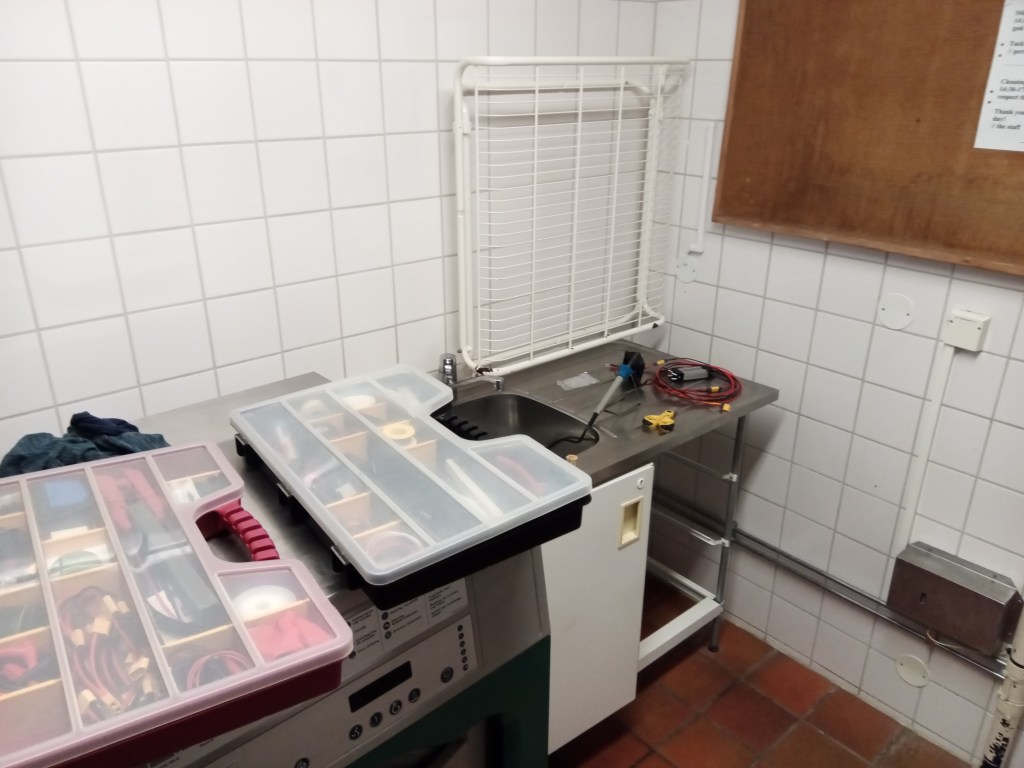
Wires and plugs were produced in the laundry room where I could power the soldering iron
Kurze Antwort: Frei von Angst bin ich nicht. Aber einschränken lasse mich auch nicht gerne von meinen Ängsten.
Angst ist wie ein wildes Tier das Du zähmen kannst und sogar an der Leine führen.
Ein gesunder Umgang mit Angst besteht für mich aus vier Schritten:
Verstehen worum es geht – “was will die Angst mir sagen?”
Maßnahmen gegen die Gefahr treffen (falls sinnvoll)
Entschluss zum Restrisiko fassen (eingehen oder nicht)
Folgen akzeptieren, mich “frei” machen
Das klingt sehr rational wenn ich das so aufzähle. Tatsächlich ist es überwiegend ein emotionaler Prozess.
Schritt 1 ist ein Interview zwischen Verstand und Gefühlen. Worum geht es eigentlich? Angst vor Ertrinken? Erfrieren? Verhungern? Danke für die Hinweise.
Schritt 2 ist tatsächlich der einzig rationale. Absichtlich. Wenn ich mir die Situation mal aus der rationalen Perspektive betrachte: welche konkreten Probleme sehe ich dann?
Diese Übung ist wichtig um in unserer heutigen, modernen Welt zurecht zu kommen. Unsere Instinkte und Emotionen stammen noch aus einer Zeit in der viele moderne Probleme oder Lösungen nicht existierten. Daher ist instinktive, emotionale Angst heute sehr selten ein guter Ratgeber. Sie produziert sowohl falschpositive (sinnlose) Ängste als auch falschnegative (scheinbare Sicherheit).
Ertrinken wäre denkbar wenn ich ins Wasser falle. Gegen das Ertrinken könnte ich eine Schwimmweste tragen. Gegen das Über-Bord-Gehen könnte ich mich mit einer Lifeline sichern. Gegen das Erfrieren könnte ich eine Trockenanzug tragen. Der verhindert die Unterkühlung im Wasser nicht, zögert sie aber deutlich hinaus. Vielleicht lange genug bis Rettung kommt. Für einen schnellen Notruf habe ich einen Satelliten-Messenger in der Beintasche. Verhungern ist hier Quatsch. Die Ostsee ist nicht groß genug dass ich manövierunfähig herumtreiben könnte bis ich verhungert bin. [Beispiele gekürzt]
Schritt 3: Möchte ich mit dem Restrisiko leben? Eventuell lange, harte Tage segeln? Kalte Hände? Kleine Schäden? Vielleicht nach Schiffbruch oder Mann-über-Bord doch unterkühlen bevor Rettung kommt?
Das ist wieder eine Kooperation zwischen Verstand und Herz. Der Verstand stellt die Fragen. Nur das Herz kann sie beanworten und sich committen.
Ja, die unbequemen Folgen kann ich ertragen. Kalte Hände und lange Tage sind OK wenn ich’s nicht vermeiden kann. Den Todesfall schätze ich für extrem unwahrscheinlich ein (beim Segeln jetzt nicht mehr wahrscheinlicher als beim Autofahren oder beim Sushi essen). In jedem Fall ist für Kira gesorgt, der Nachlass ist geregelt.
Schritt 4 ist dann das Anleinen der Angst. Eine fast reine emotionale Übung. Das Verstand ist gerade noch Zeremonienmeister.
“Schau Angst, wir haben es alles besprochen. Ich habe Dir zugehört. Dann habe ich ein paar moderne Sachen gemacht die Du nicht verstehen kannst. Das restliche Risiko ist lange nicht so groß wie Du es am Anfang gesehen hast. Das kann ich eingehen. Danke für Deine Warnungen.”
Der Text oben klingt rational. Meine Angst möchte ich nicht ignorieren oder überreden, sondern mit ihr verhandeln und arbeiten.
Wesentlich ist das Hineinfühlen in mich selbst. Wie wirkt die Situation jetzt, in Schritt 4, gefühlsmäßig auf mich? Ballt sich der Magen zusammen? Atme ich flach? Kann ich mich wieder entspannen? Kommt Freude auf?
Es hatte wohl gute Gründe warum ich 5 Wochen lang in Großenbrode gebraucht hatte bevor ich lossegeln konnte. Einige Zeit war logistisch bedingt (Einkäufe, Planungen, Hundeübergabe). Weitere Zeit brauchte ich für Training und Selbststudium. Geschätzte 2 Wochen brauchte ich für das mentale Training wie oben beschrieben, bis ich schließlich leicht im Herzen und mit frohem Mut aufbrechen konnte.
Der aktive Umgang mit Angst ist mir irgendwann beim Klettern bewusst geworden. Seitdem praktiziere ich diese Übungen entweder regelmäßig (z.B. integriert in den Sport) oder situativ. Die intensivsten Trainingseinheiten durfte ich beim Brückenspringen erfahren. Sport ist dabei eine nützliche Bühne. Von dort kann ich die Technik auch auf alle anderen Lebensbereiche übertragen (z.B. Beruf, Liebe oder Finanzamt).
Was ich euch damit erzählen möchte:
Angst ist selten ein guter Ratgeber
Gesunder Umgang mit Angst ist trainierbar
Mit Angst an der Leine ist das Leben unbeschwerter und glücklicher
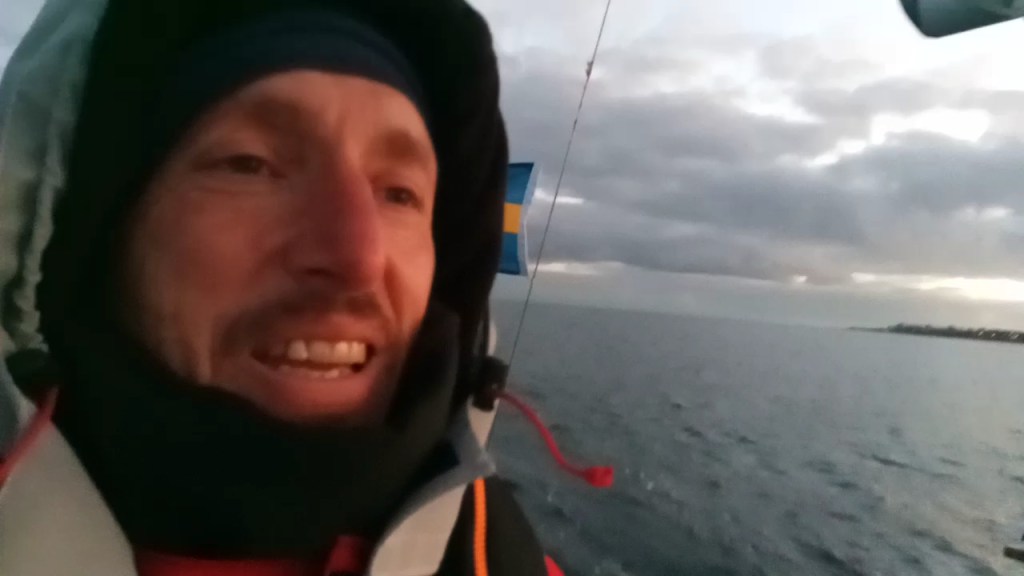
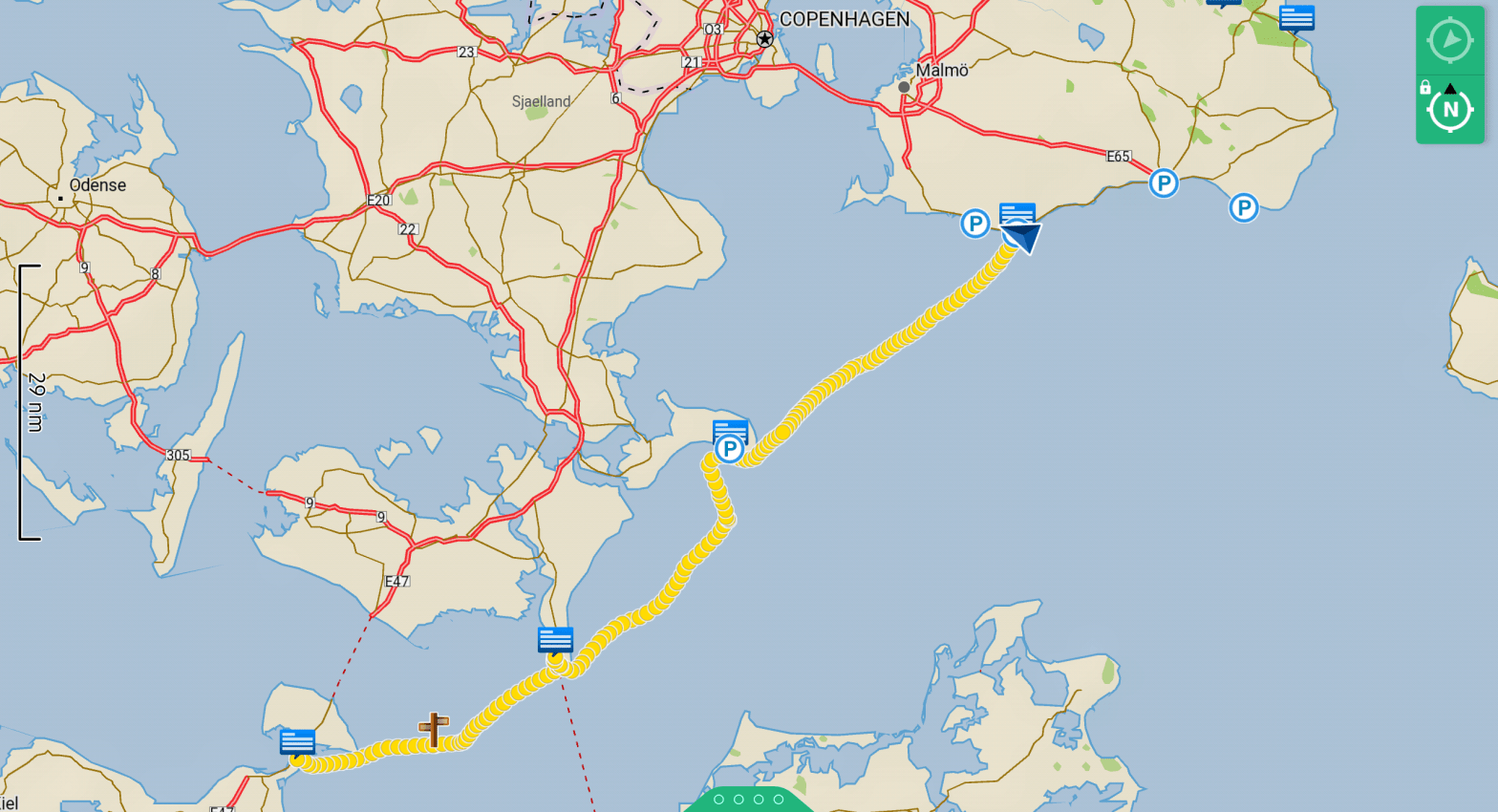
To complete the Baltic Sailing tour, yesterday I sailed the 4th part and finally arrived well at Simrishamn.
Happy to arrive at the final destination
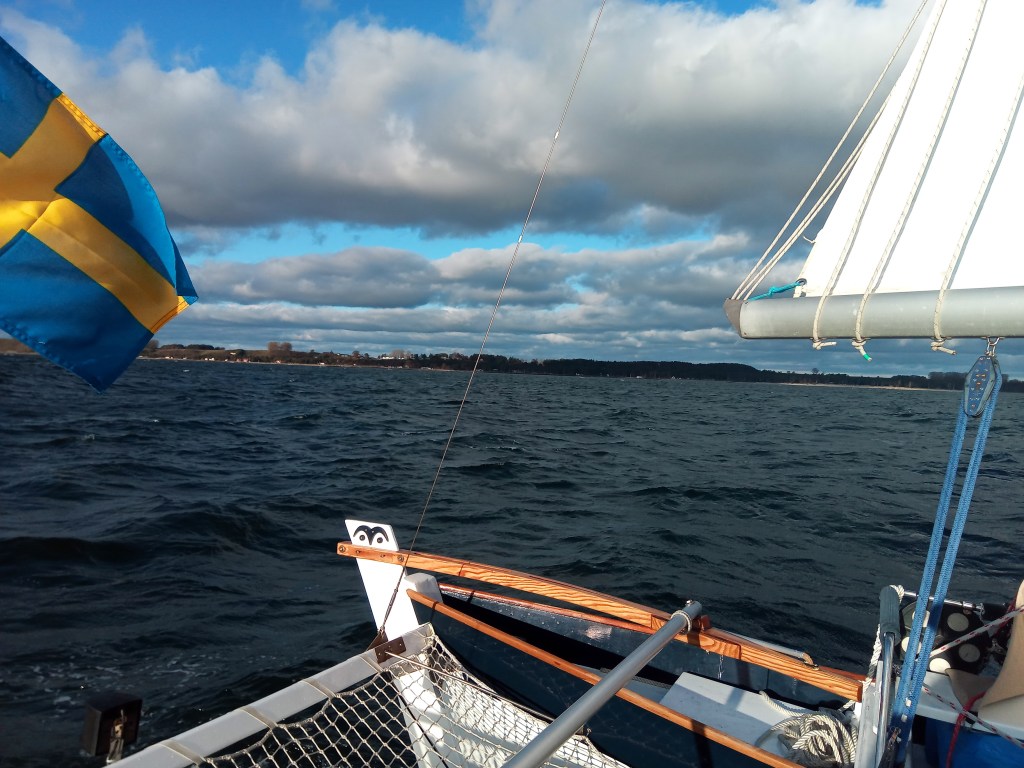
It was another day of downwind sailing. For a while the wind was pushing me fast enough so that I could catch waves and surf them briefly.
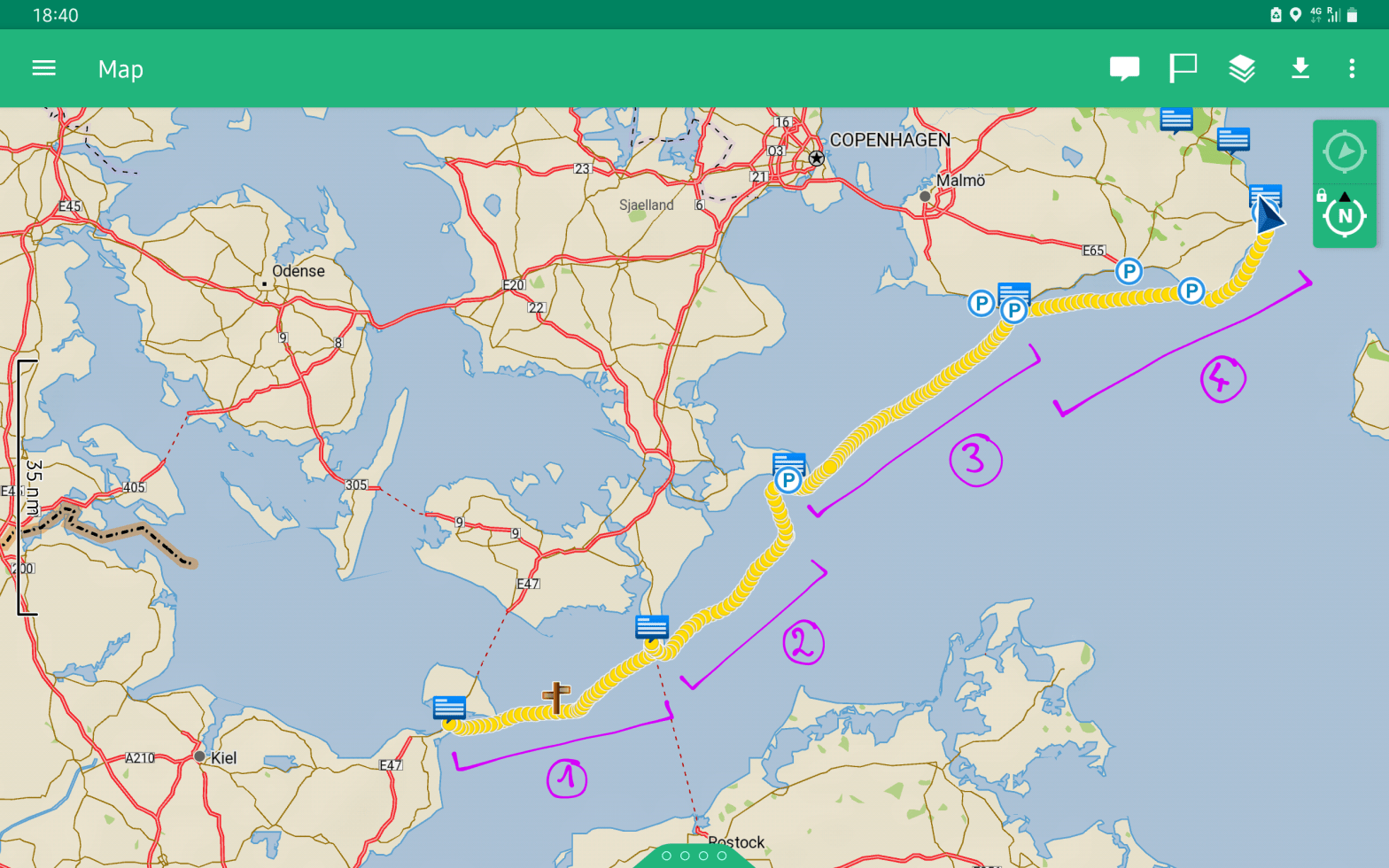
Also it was the longest distance (44 nautical miles) of all 4 sailing days in the shortest time (8 hours).
Here are some statistics:
From Großenbroder Fähre (DE) …
1. 35 NM in 08:27, by the wind (am Wind), to …
Gedser (DK)
2. 38 NM in 08:22, downwind course, to …
Klintholm (DK) including rest day due to calm wind (Flaute) forecast
3. 41 NM in 10:56, using 70% of my batteries due to calm wind (not as forecast), to…
Smygehuk (SE) including rest day due to hard opposing wind forecast
4. 44 NM in 7:51, downwind course, to …
Simrishamn (SE) – terminal station. Alles aussteigen bitte.
Fun fact: the distance had increased by 3 NM each day on my tour.
I am pleased to see that the whole tour went exactly according to the plan. It shows that either I was incredibly lucky or well enough prepared. Or reasonably prepared and a bit lucky. And certainly I had a lot of support (see previous post)
In the evening I enjoyed strolling through the small town’s streets and eating a nice Thai dish. Every street was lit by candles or light projections because of a local festival.
After 5 weeks in Germany I felt like a valid (not second-class) member of society.
Erst in Schweden wurde mir klar, wie bedrückend die letzten 5 Wochen in Deutschland für mich waren. Die Auflagen zur so genannten Pandemiebekämpfung sind inzwischen zur Normalität geworden. Die Mehrheit der Menschen in DE akzeptiert, unterstützt oder erzwingt die Maßnahmen (es gibt auch erfreuliche Ausnahmen). Als Ungeimpfter bin ich in Restaurants und von manchen Veranstaltungen ausgschlossen. Als Maskenkritiker hielt ich mich freiwillig so weit wie möglich von Geschäften und Öffis fern. In Gesprächen vermied ich das Thema und meinen Impfstatus um nicht unnötig zu spalten. Insgesamt fühlte ich mich in DE als Teil einer entrechteten Randgruppe, als Bürger 2. Klasse.
In Schweden sind weder Masken noch Tests oder gar Impfungen im öffentlichen Leben vorgeschrieben.
Today my dear friends Monika, Christian and Gaurangi came to visit me at Sim City. We strolled through the town, visiting shops and barbers and cafés. What a nice first day in my new home town!
Tomorrow I will go sailing… for the first time just for pleasure and not with a logistical goal.
Wishing you a good night and sending you energy to achieve your goals!
Vielen Dank für eure Glückwünsche. Thank you for your kind comments here and on Telegram ❤️
For me the main goal of this trip is now achieved. I have travelled from Germany to Sweden. 116 nautical miles (215 km) in 3 sailing days, exactly as planned. The rest is details.
Still I am a bit confused because I have two completely different impressions of this accomplished task:
1. From a rational perspective, and in advance, it seemed unbelievable. Acquiring a used boat and sailing it long distance as a beginner in late autumn is a task that I would not recommend to a friend.
It is literally exceptional for an experienced sailor. Most refused to join me when I asked them. Along the way I met exactly one other sailing yacht.
For a beginner it seems just stupid to attempt.
2. From an emotional perspective it felt a little exciting in advance but completely normal in each and every moment. It felt just right.
The main challenge to me was the innovation (so many new things to learn and skills to train) but neither the nature nor magnitude of this project. Many other people have sailed much longer and much more extreme tours.
Well, I added the other challenge of converting Maru into a green hybrid boat (powered by wind + electricity). I replaced the proven Yamaha engine with a relatively new company’s new product: an electric outboard engine, together with 100 kg of batteries. I installed the final missing cables just in the night before I started to sail. Now I am so happy that I converted it: all went well. No noise, no fumes, no petrol fingers after refilling. Cruising with help of the silent engine almost all day (on Wednesday) was a pure pleasure.
Before the trip I expected (not only hoped) the best.
Risk management intermezzo – please stop me when I go too deep here:
For various reasons I prepared for the worst (testament, life vest, dry suite, satellite messenger, published plan, real-time tracking and supporting sailor Michael…). In risk-management terms I accepted the residual risk [Restrisiko].
What was the remaining worst event that could happen? In the unlikely event of falling off board I would float in the Baltic Sea, sending SOS via satellite messenger (always worn on my body) waiting for rescue (quite likely) before I die of hypothermia [Unterkühlung] (unlikely multiplied by unlikely).
The wooden catamaran with no ballast in the keel is practically unsinkable. In case of major damage (like a hull breach) to the boat (unlikely), I would still float on board and have days of time for survival before rescue.
(Risk Management over)
With the acceptance of residual risk, my mind and my heart could focus on the sailing task.
Nach intensiver Analyse und Anwendung vieler Gegenmaßnahmen konnte ich das Restrisiko gut akzeptieren. Und mit dieser Akzeptanz konnten sich mein Herz und mein Verstand unbeschwert auf die eigentliche Aufgabe konzentrieren: das Segeln.
Ängste dürfen an Land bleiben.
Dann kommt alles in Fluss. Die Performance steigt und natürlich auch der Genuss.
Still I have a lot of respect for the craft of sailing. Being a beginner I don’t want to fall for the Dunning–Kruger effect, also known as “standing on Mount Stupid”. Certainly I did a lot to prepare myself. Yet I could have been lucky. I am not an experienced sailor now. Let’s keep that in mind when we go on a sailing trip together.
I am so grateful for all the lovely people that I met during the past weeks and who supported me. My journey would have been different, most likely harder, without our support!
Credits go to mainly to:
Josef and Jojo vom Walchensee: thank you (besides all the other stories) for your initial sailing lessons. Josef, as always: it is great to see how well you manage gear and situations. Das legt die Messlatte hoch und motiviert mich immer wieder, in ausgewählten Bereichen ähnliche Kunstfertigkeit zu erreichen.
Volker the sailor from Baden-Württenberg: thank you for taking me with you on this heart-opening day trip!
Hans, the owner of Dotterbart. You did not sell me your boat in the water. That triggered a lot of thinking and increased my respect for the sea at winter time.
Rolf, the previous owner of Maru. Du hast Dir unendlich viel Zeit für Erklärungen genommen, nicht nur zu Maru speziell sondern zum Segeln und zur Ostsee ganz allgemein. Danke dass Du mir die großartige Maru überlässt.
Robby, Segellehrer und coole Socke. Die Segelstunden mit Dir zeigten mir wie lässig man (Du) auch in kitzligen Situation mit dem Boot umgehen kann, dass ein Segelboot manchmal ein Windsurfer ist, und dass ich das alleine machen soll.
Stephan Redecker, sailor and crew member at a boat shop. All your advice and research helped me to select the best equipment possible – most importantly the electric conversion.
Thorsten, Segler und Anwohner in Großenbroder Fähre. Danke für die guten Gespräche, Tipps und für das Werkzeug.
Angelika und Klaus aus Großenbroder Fähre: Vielen Dank für eure lieben Einladungen und für die Reflektionen über das Segeln und das Leben. Das waren sehr wohltuende Stunden für mich im kühlen Hafen.
Klaus Christian aus Großenbroder Fähre: danke auch für Deine Ratschläge.
Roland mit Django aus Großenbroder Fähre: vielen Dank für eure Gesellschaft beim Spazieren mit Kira und für die anregenden Gespräche. Alles half um mich zu sortieren.
Kira und Django
Edith Dobert, Segelschule Fehmarn: thank you for planning the initial tour. Only due to bad weather and a technical defect (Yahama) we could not execute it. Your checklists were helpful for my solo tour.
Matthias aus L: danke für Deinen Besuch und für die stets tiefgehenden Diskussionen. Sie justieren auch meinen moralischen Kompass immer wieder nach.
Fabian aus der Schweiz: thank you for your skipper advice, specifically about this part of the Baltic sea.
Michael Held, crew member at the electric engine’s manufacturer, for identifying and solving the missing parts in the electric conversion.
Michael, Matze und Christoph von der Sym: danke für eure unendliche Flexibilität für meine seltsamen Zeitfenster und Kommunikationskanäle.
Michael Freitag von remote: thank you for all the generic and specific advice, coming from your life long sailing experience, and thank you for the real-time tracking support. Also your happy attitude to life is always inspiring to me.
Various people in various stores (Germany) for tolerating me not wearing a mask during my visits. I won’t mention names so they don’t get their asses kicked by bosses or authorities.
All you readers and commenters here and on Telegram. Your feedback is one of my driving forces. Also it helps me balancing between reality and illusions.
Besonders Katerina aus Lenggries. Vielen Dank für Deine moralische und praktische Unterstützung jederzeit, und für den sicheren Hafen für Kira!
Also many other kind people. If I forgot to mention someone then my memory is to blame.
I wish you all a good night now. Tomorrow I will continue sailing East, either to Ystad or Kåseberga or Simrishamn – depending on the average speed and progress.
Today was very little wind, so I chose to stay in Klintholm and use the day in different ways.
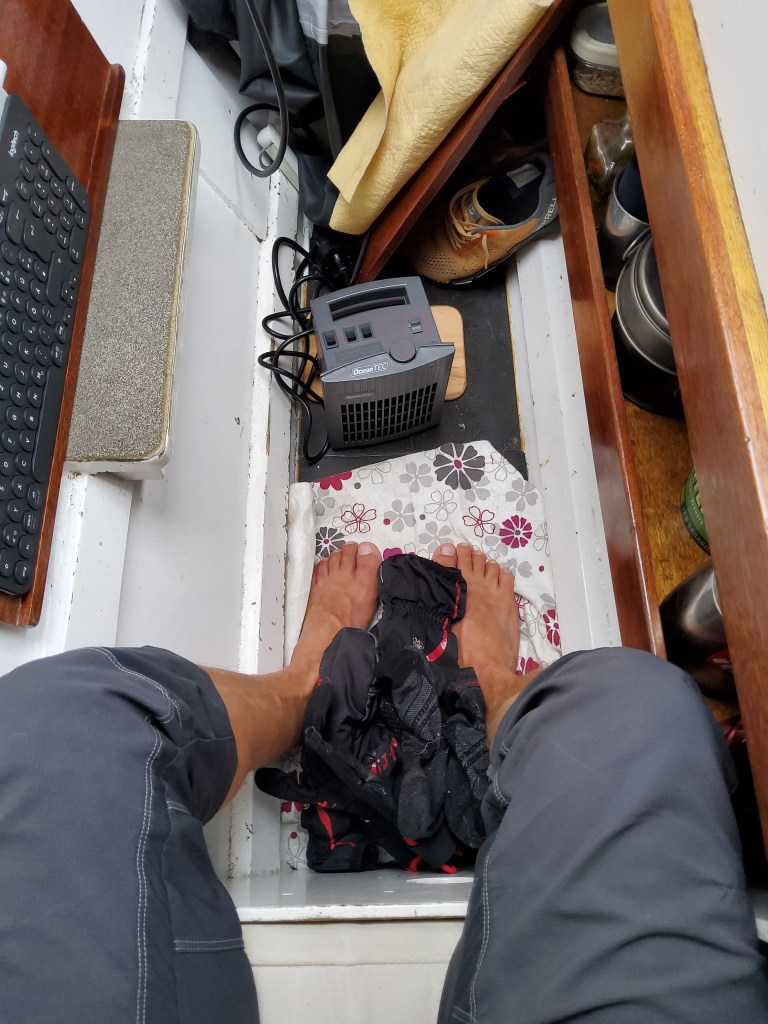
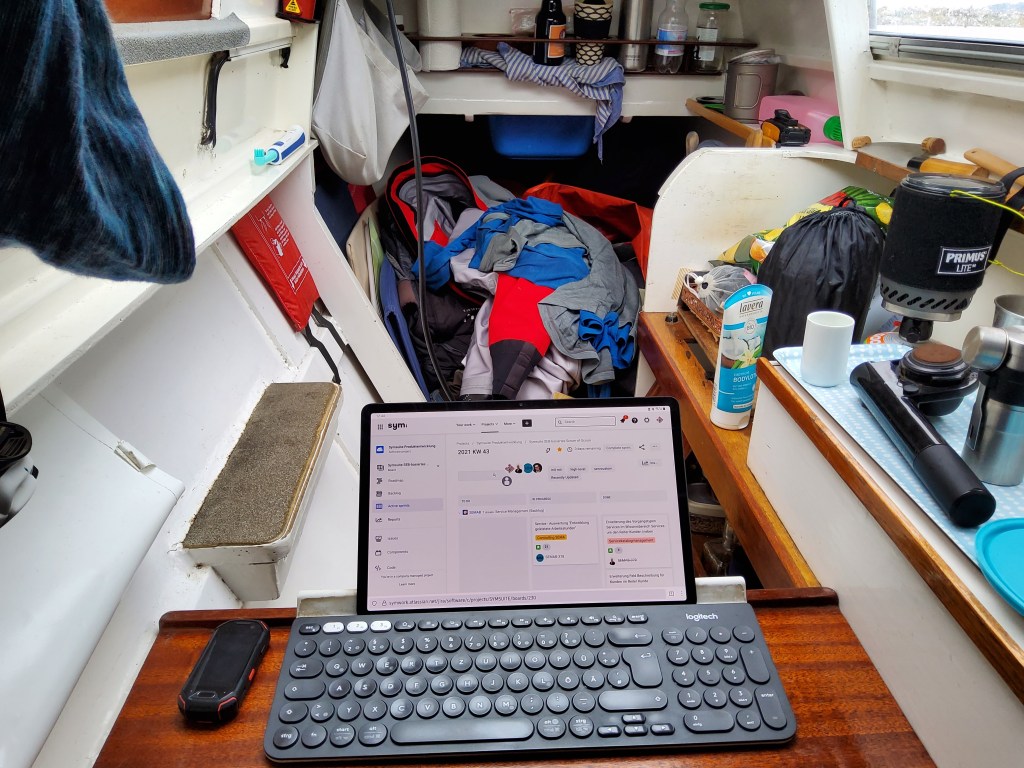
drying gloves and warming feetworking half day
Paying bills. Taking a nice, hot shower in the harbour.
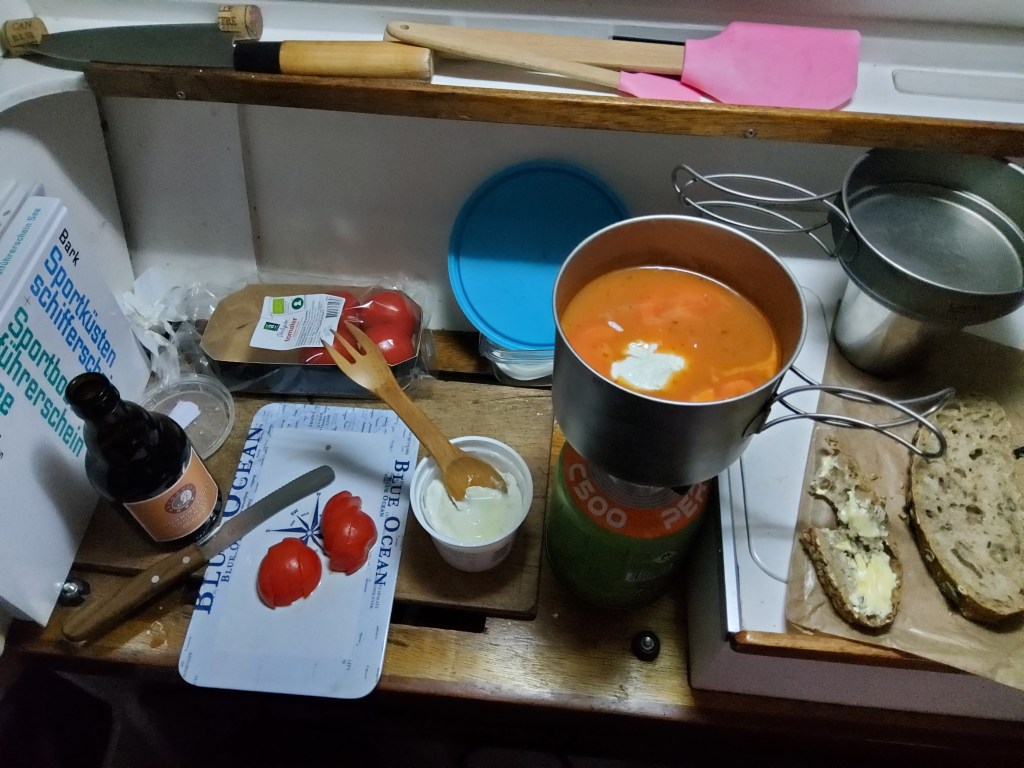
cooking delicious dinner
Checking weather.
Researching on how to use the 42 m² “blister” (or gennaker) sail for tomorrow, which will be another day with little (but some) wind from behind.
Reading about different harbours on Sweden’s South coast (in case I cant get to Smygehamn). Looking up lighthouses along my route and learning their light signatures (individual sequences of bright light and pauses). Repeating rules about navigation lights on different types of boats, because along my way I will cross some major paths for the big, commercial ships.
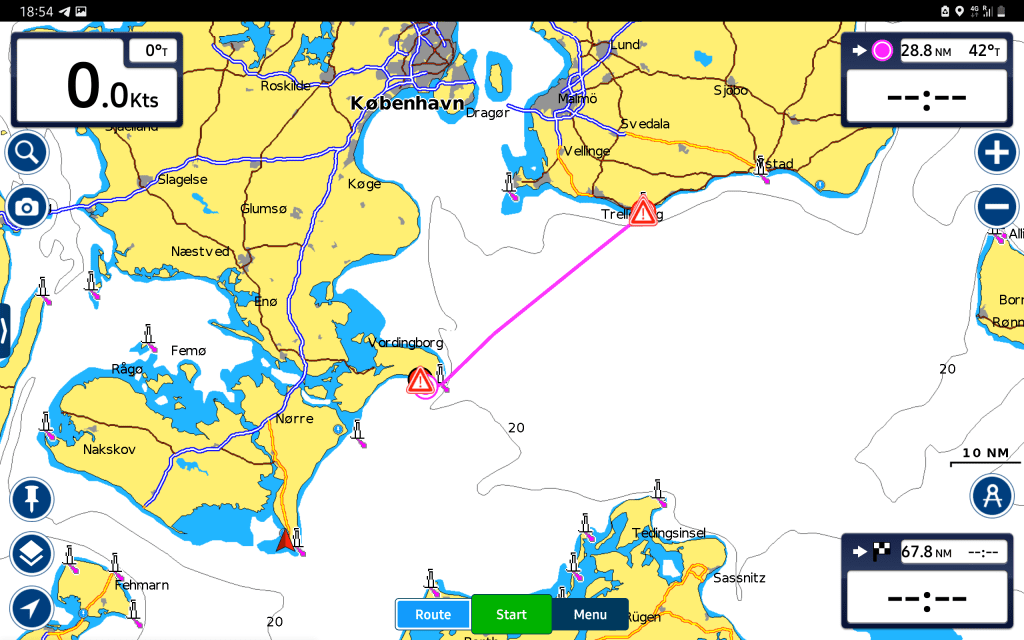
Tomorrow will be the longest leg of my tour (40 nautical miles) which I will sail probably at the slowest average speed – so it could get dark before I arrive.
I am quite curious how it will work. As always, you can follow my track here:
 Touring Test